

Livity Tree Art Presents · Katherin Joyette · May 27
THE
ERASED
DAUGHTERS
ERASED
DAUGHTERS
An Afro-Caribbean Matriarchal Art Exhibition
Scroll to Enter
I
 LIVITY TREE OF LIFE · KATHERIN JOYETTE
Act I · The Root Speaks
Where Ancestry
Where Ancestry
Becomes Art
The tree does not remember migration. It remembers the soil it entered — the mineral signature of a particular ground, a particular water, a particular ancestor who held ceremony on that land. Livity Tree Art was built on this remembering.
The Erased Daughters is not an exhibition of grief. It is an exhibition of return. Three lineages — Eritrean Royal, Arawak-Kalinago, and Irish-Fir Bolg — did not converge by accident. They converged because the same colonial mechanism erased each of them. The same eight-step operation. The same severing from the ancestors within the land. This show names that operation, and names the mothers it tried to silence.
Katherin Joyette · Decolonial Scholar · Cultural Artist · Founder
✦
II
Chapter One
The Royal
The Royal
Eritrean
Mother
Le'elt Lineage · Princess Etherline
She held the Le'elt title. She was a princess of the Eritrean royal line, and her granddaughter carries that sovereignty not as a relic, but as a living transmission — encoded in art, in scholarship, in the matrilineal memory that colonial census systems tried to reclassify as nothing.
"They reclassified the queen into a category. The category was designed to make her disappear. The work of this exhibition is to make her visible again."
The Eritrean chapters in this show draw on the Asherah archetype — the feminine vessel of ancestral wisdom that predates every Abrahamic institution that tried to erase her. Lunar sovereignty. Matriarchal intelligence. The Le'elt title did not die when it was suppressed. It waited in the bloodline, encoded in five converging lineages, surfacing now in art.
☽
Le'elt · Royal Title
Eritrean Matriarchal Line
Eritrean Matriarchal Line

LEANA DE JUDAH · ANCESTRAL INTELLIGENCE SERIES
"Five converging lineages.
One sovereign daughter."
One sovereign daughter."
✦
III


TRIPLE SPIRAL ABORIGINAL GODDESS SERIES · SPIRAL GODDESS COLLECTION
Chapter Two
Arawak ·

Arawak ·
Kalinago ·
The Caribbean
Mother
"Before there was a category for us, there was ceremony."
Maternity · A Caribbean Reclamation of the Aboriginal Mother
Picasso's 1901 Maternity placed the colonial gaze at the center of the maternal image. This exhibition places it where it belongs: with Taíno, Arawak, and Lucayan women, in their own sacred visual language, centered in their own sovereignty.
The Kalinago were among the first peoples the colonial project needed to erase — because their matriarchal governance structure, their astronomical knowledge encoded in spiral geometry, and their spiritual relationship with the land could not coexist with a deed of ownership. The spirals in this show are not decoration. They are counter-documents.
Taíno
Arawak
Lucayan
Kalinago
✦
IV
Chapter Three
The Irish
The Irish
Daughters ·
Fir Bolg
Substrate Peoples · The First Template
The Fir Bolg are what colonial mythology calls "the conquered ones" — the substrate people of Ireland buried beneath the Tuatha Dé Danann narrative. But in Katherin's Parallel Emergence Framework, they are not the defeated. They are the original template, expressed independently across every continent.
Parallel Emergence Framework
Small substrate peoples — Fir Bolg, Negritos, Twa, Tennessee burial peoples, Andamanese, Red Ocher mound builders — represent the original human template expressed independently worldwide. Not an Out of Africa migration chain. A parallel emergence. The same mother, remembered everywhere.
The Irish chapters in this show draw a direct line from the Kalinago spiral to the Irish triple spiral — the same sacred geometry, the same substrate cosmological grammar, encoded across thousands of miles and thousands of years. The same mother, drawn by different hands, never quite erased.
✦
IV+
The Blood That Made the Bridge
The Families
Daly · Dowdy of Montserrat · Joyette of St. Vincent · Yurumein
The Families
Behind the Work
Daly · Dowdy of Montserrat · Joyette of St. Vincent · Yurumein
🌿 Montserrat · The Emerald Isle of the Caribbean
Daly
& Dowdy of Montserrat, West Indies
& Dowdy of Montserrat, West Indies
The Daly name did not arrive in Montserrat clean. It arrived through the mechanism that built the Caribbean — through indentured servitude, through forced labor, through Irish Catholics displaced from Ireland and deposited on an island that was already someone else's land. The Arawak and Carib peoples had held Montserrat long before the first Irish foot touched its volcanic soil in 1632.
"In Montserrat, the Irish names are not a legacy of triumph. They are a record of erasure — and of survival from both sides of the plantation gate."
The Daly and Dowdy families became Caribbean families the way all families in that archipelago did — through collision, through intermarriage, through the synthesis that colonialism forced and that the people themselves made sacred. The Irish-African-Karib synthesis on Montserrat produced what historians call the "Black Irish" — a people who carry Celtic surnames, speak with the faint echo of an Irish brogue, and trace their African and Aboriginal ancestry back through generations that no census was ever designed to honor.
On March 17, 1768 — St. Patrick's Day — the enslaved population of Montserrat rose up while their masters celebrated. The rebellion failed. The ringleader Cudjoe was executed. But the date was never forgotten. Montserrat is still the only nation outside Ireland where St. Patrick's Day is a national holiday — and it commemorates not the Irish, but the freedom fighters who wore their names.
Island Name (Kalinago)Alliouagana — "Land of the Prickly Bush"
Original PeoplesArawak · Kalinago (Carib) · Pre-Columbian
Irish Arrival1632 · Anglo-Irish Catholics via St. Kitts
Daly LineageIrish-Caribbean · Matrilineal Montserrat Branch
RebellionMarch 17, 1768 · St. Patrick's Day Uprising
SynthesisAfrican · Irish · Aboriginal Karib · One People
🌀 St. Vincent · Yurumein · Land of the Blessed
Joyette
of St. Vincent & the Grenadines · Yurumein
St. Vincent was called Yurumein by the Garinagu — the people the British renamed "Black Caribs" to strip them of their land claim. The Joyette family root is in this soil: the island where Kalinago warriors, free Africans from shipwrecks, and Arawak matrilines merged into a people that no colonial category could contain. The Garifuna held Yurumein until 1797, when the British — after decades of war — deported 4,338 of them to Roatán, Honduras.
"The Joyette line carries Yurumein in its blood — the island where the Kalinago and the free Africans refused to be separated, and built a nation the British could only defeat by erasing its name."
Ormiston Leo Joyette of St. Vincent carried this heritage into the diaspora — through his daughter, through his granddaughter Katherin, through the five converging lineages that now live in the art of Livity Tree Art. The Joyette name is not a colonial imposition. It is a survival. It is the name the family kept, through Middle Passage, through plantation, through 1797, through the long migration north, and into the hands of an artist in New Bedford, Massachusetts, who is currently hanging their mothers on gallery walls.
The Garifuna spiritual tradition holds that the worlds of the living and the dead are not separate — that ancestors visit through dreams, through ceremony, through the hands of those who remember. This exhibition is that visitation, made visible.
Island Name (Garifuna)Yurumein — "Our Blessed Home"
Original PeoplesArawak · Kalinago · Free West Africans
Garifuna Formed17th Century · Afro-Indigenous Synthesis
British Exile1797 · 4,338 Garifuna deported to Roatán
Joyette LineageOrmiston Leo Joyette · St. Vincent diaspora
Ancestral LanguageGarifuna · Arawakan · UNESCO Heritage

Anthony Joyette
1949 – 2014 · Legacy Artist · Montreal · Among the First Black Canadian ArtistsThe Joyette artistic lineage did not begin with Livity Tree Art. It began with Anthony Joyette — poet, visual artist, and one of the first Black Canadian artists to receive formal recognition in Montreal. He understood that Caribbean voices needed to be present in the spaces where they had been erased. His vision of art as resistance, as cultural reclamation, as a transmission across time, is the heartbeat of everything his niece Katherin now creates. The uncle planted the seed. The daughter of St. Vincent grew the tree. The tree is now flowering in New Bedford, Massachusetts, and the blooms carry the names of every ancestor who was told their name did not matter.
"Montserrat and St. Vincent are not footnotes in Caribbean history.
They are the living record of what happens when peoples who were meant to be erased
find each other — and decide to remember together."
✦
The Ancestral
Bridges Converge
Three lineages. Three erasures. Three sets of daughters whose names were reclassified, whose sovereignty was buried, whose cosmological knowledge was rebranded as superstition. But the bridges between them were never destroyed — because you cannot destroy the grammar of a people. You can only try to bury the language.
Eritrean Royal
Le'elt lineage. Lunar sovereignty. The Asherah archetype. Five converging matrilines encoded in one daughter.
Arawak · Kalinago
Caribbean Aboriginal mothers. The spiral as counter-document. Maternity reclaimed from the colonial gaze.
Irish · Fir Bolg
Substrate peoples of Ireland. The parallel template. The same geometry. The same original mother, remembered in stone.
This is the Ancestral Bridges framework made visible. Not in text. In paint. In sacred geometry. In the bodies of the mothers.
✦
V+
Featured Artist · Charlie's Collection · Livity Tree Art
A New Voice in the Lineage
Charlie
Andrade
Cape Verdean Artist · South Shore · Andrade Family Artistic Legacy
The Andrade family artistic lineage did not stop. It passed — the way real lineages do — not through institution, but through blood, through proximity, through a young artist on the South Shore of Massachusetts who picked up a brush and already knew something about sacred vision.
"The Eye of Ra does not belong to the past. It belongs to whoever still has the courage to open it."
Charlie Andrade is a Cape Verdean-heritage teen artist whose debut work on Livity Tree Art carries the full weight of what the platform was built for: ancestral transmission across generations, expressed through someone young enough to make the elders proud and old enough in spirit to understand why it matters.
Her Eye of Ra is not a reproduction of an Egyptian motif. It is a recognition — a Cape Verdean granddaughter looking into the same ancient sun that her African ancestors looked into, and painting what she sees. Her Cape Verdean Hibiscus portrait places the island's most sacred flower at the center of a visual cosmology that refuses to be decorative. Both pieces are on display in The Erased Daughters show.
 Eye of Ra · Charlie Andrade
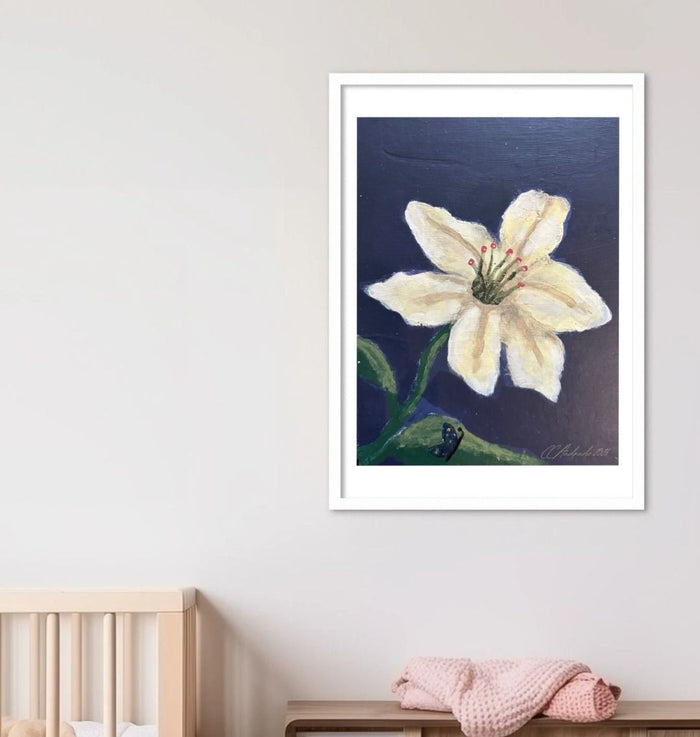

Cape Verdean Hibiscus Portrait · $209.99 · Charlie's Collection
 Eye of Ra · Variant
Eye of Ra Landscape Art Print · $159.99 · livitytreeart.com
Why Charlie Is Here
Livity Tree Art has always been about the transmission — the passing of the flame from one generation of rememberers to the next. Charlie Andrade is that next generation. Cape Verdean, South Shore-rooted, and already painting with the vision of someone who understands that art is not expression. It is covenant.
Exhibition Preview
Works in the Show


The Erased
Daughters
An Afro-Caribbean Matriarchal Art Exhibition
DateMay 272025 · New Bedford, MA
Artist & CuratorKatherin JoyetteDecolonial Scholar · Cultural Artist
Massachusetts Cultural Council Grant Recipient
Massachusetts Cultural Council Grant Recipient
PlatformLivity Tree Artlivitytreeart.com
livity.blog
livity.blog
"They did not erase our mothers. They buried the name — but the root held. These works are the root, speaking back through the daughters it never stopped carrying."
 Massachusetts Cultural
Council Grant Recipient
Artist & Founder: Katherin Joyette

Erased
Daughters Art Book:
A Journey Through the Caribbean
and Its Sacred Mothers
Livity Tree Artists
The Artists Behind the Work
Livity Tree Art is not a brand conceived in a marketing meeting. It is the living continuation of a matrilineal legacy spanning Kalinago St. Vincent, Eritrean royal lineage - grandparent lineages, each carrying sovereign Indigenous identity, spiritual authority, and noble standing that colonial reclassification buried.
The late Anthony Joyette — among the first Black Canadian artists recognized in Montreal — planted a seed that now blooms through Katherin and the entire Livity Tree Art family. His vision of art as resistance, as cultural reclamation, as a transmission to future generations, is the heartbeat of everything we make.
Charlie Andrade

Cape Verdean Artist · South Shore, Massachusetts · Charlie’s Collection Charlie Andrade is the proof that a lineage does not end. It waits. Then it arrives again, in a new set...

Charlie Andrade
Charlie Andrade
|Katherin Joyette
Katherin Joyette

Katherin Joyette is an Afro-Indigenous artist, storyteller, and founder of Livity Tree Art. Her work is rooted in cultural memory and resistance, weaving together the ancestral threads of the Caribbean,...

Katherin Joyette
Katherin Joyette
|Katherin Joyette
Robert Joyette

Robert Joyette is a multidisciplinary fine artist from the island of St. Vincent and the Grenadines, whose work channels the spirit of resistance, ancestral memory, and cultural reclamation. A graduate...

Robert Joyette
Robert Joyette
|Katherin Joyette
Rooted in the Caribbean Aboriginal
The Kalinago, Arawak, and Ciboney peoples were the first nations of the islands the world now calls the Caribbean. Their cosmology, matrilineal kinship structures, and earth-based spiritual practices form the living root of Livity Tree Art.
Art as Ancestral Transmission
Our art is not decorative. It is channeled through ceremony, breathwork, meditation, and deep ancestral research. Each piece carries encoded cultural memory — a portal to lineages that colonial history tried to erase.
Living the Culture — Not Displaying It
Livity means the culture lives through you. Not behind glass. Not on a shelf. On your body, in your home, in your daily choices. You are not a museum visitor — you are a living heir.
Your Ancestors
Were Never Lost.
Only Waiting.
Bring them home. Hang them on your walls. Wear them on your skin. Carry them in your accessories. Livity Tree Art exists so that the first peoples of the Americas and Caribbean are never erased again.
Aboriginal Amerindian Art & Culture